Evaluate one litter before moving your archive
Prepare parent details, kitten identifiers and a copy of records you are comfortable using in a trial. Find the litter, record one kitten, review its date and unit, and inspect the sharing settings. Note any step that needs duplicate entry or manual reconciliation.
Spreadsheets can represent relationships with identifiers, multiple sheets and formulas. Specialist software earns its place when it reduces the work you actually do. A missing feature matters only if you need it; there is no universal number of modules that determines whether a tool fits.
A practical cattery software checklist
| Area | What to try | What to clarify |
|---|---|---|
| Cats and litters | Check kitten-to-litter and parent links, including animals with similar names. | Use identifiable records, not just an empty feature demo. |
| Weights and daily care | Enter the event date, value and unit; retrieve and correct a record. | No entry today does not prove the kitten was not weighed. |
| Plans and reminders | Keep planned dates separate from completed events and link tasks to an animal. | Due dates are estimates; notification delivery depends on settings and environment. |
| Pedigrees and documents | Keep parent links, identifiers and the source of supporting documents. | A self-entered pedigree is not a certificate issued by a registry. |
| Collaboration and sharing | Check staff access and the fields visible to a buyer. | Review internal and public views separately; keep private notes and contact details private. |
| Exports and leaving | Check file formats, fields, media coverage and required plan. | Open an export yourself. Cloud storage is not a separate backup you already control. |
FanMeowy platforms, free allowances and paid plans
FanMeowy is the brand behind this app. Its US App Store name is “Cattery Manager: Breeding”; the China and Taiwan listings use 宠舍管家 and 寵舍管家 respectively. All three refer to the same App Store entry, 6753983437. They should not be compared as separate products.
On 12 September 2026, the China App Store listing showed version 3.0.8 with a free download price. The official website also provided Android APK and macOS DMG links. Check your own storefront, language and required features; this verification does not establish identical availability or functionality on every platform.
A free download and free use of every feature are different things. The following describes the default product configuration checked on that date. Review the terms shown for your account and device before an action or purchase.
| Item | Current description | Before you choose |
|---|---|---|
| Daily records and bookkeeping | Currently unlimited by default, with no ad unlock configured for these two actions. | Other features may have limits or separate charges. |
| Profiles and breeding plans | Default free allowances are 20 and 1; overflow entry points are configured for optional rewarded-video unlocks. | Check the current counter and unlock prompt. Ad availability is not guaranteed in every region. |
| Membership | Fixed-duration, one-time purchases coexist with monthly and yearly auto-renewing iOS plans. | A one-time purchase for a stated term is not a lifetime licence. Check renewal type and included benefits. |
| Other costs | Some AI features use credits called Pet Beans; dedicated mini-program offerings have additional cost boundaries. | Check whether platform certification and design services are included or separately charged. |
Real walkthrough: from missing weight entries to a litter form
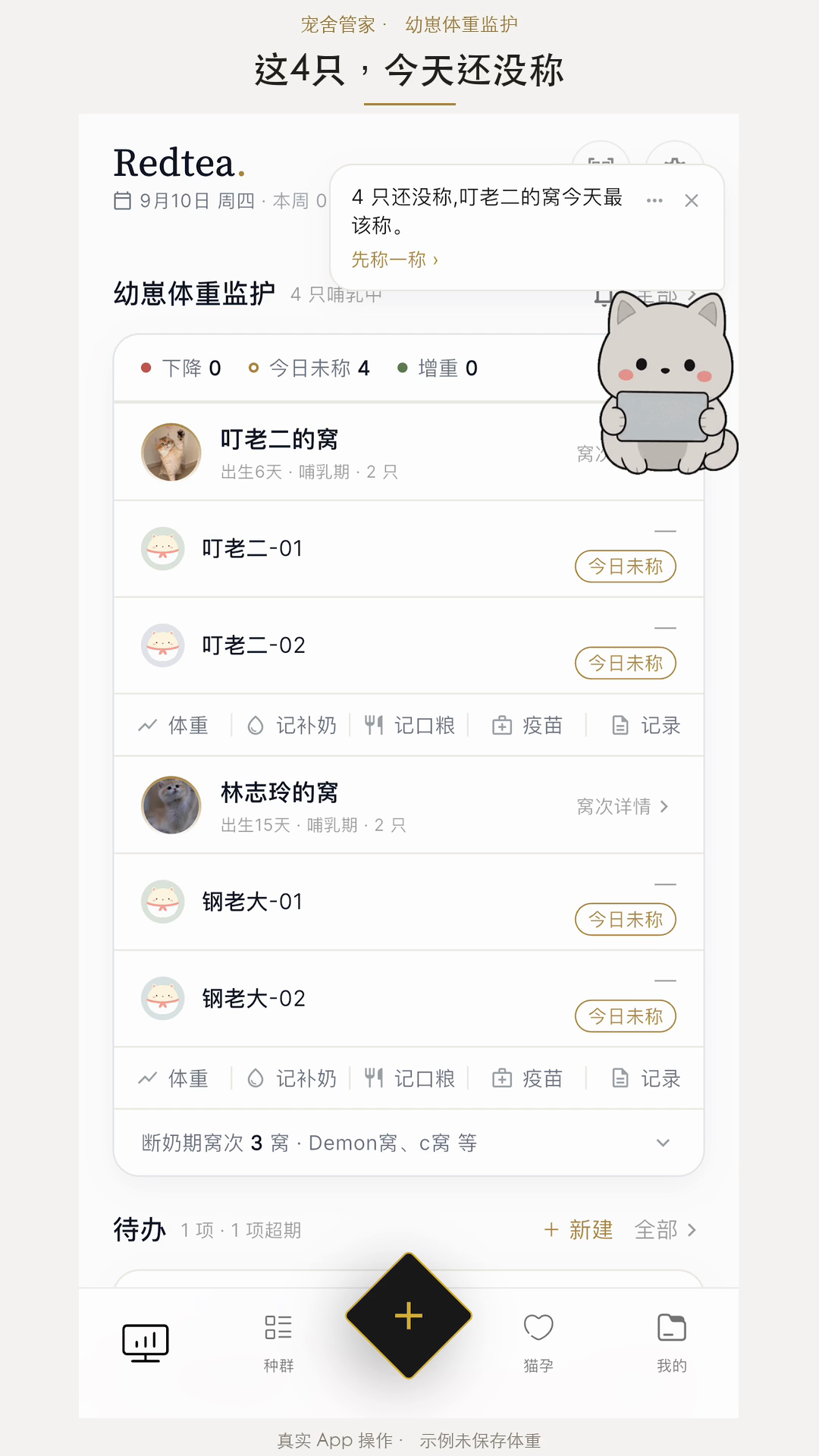
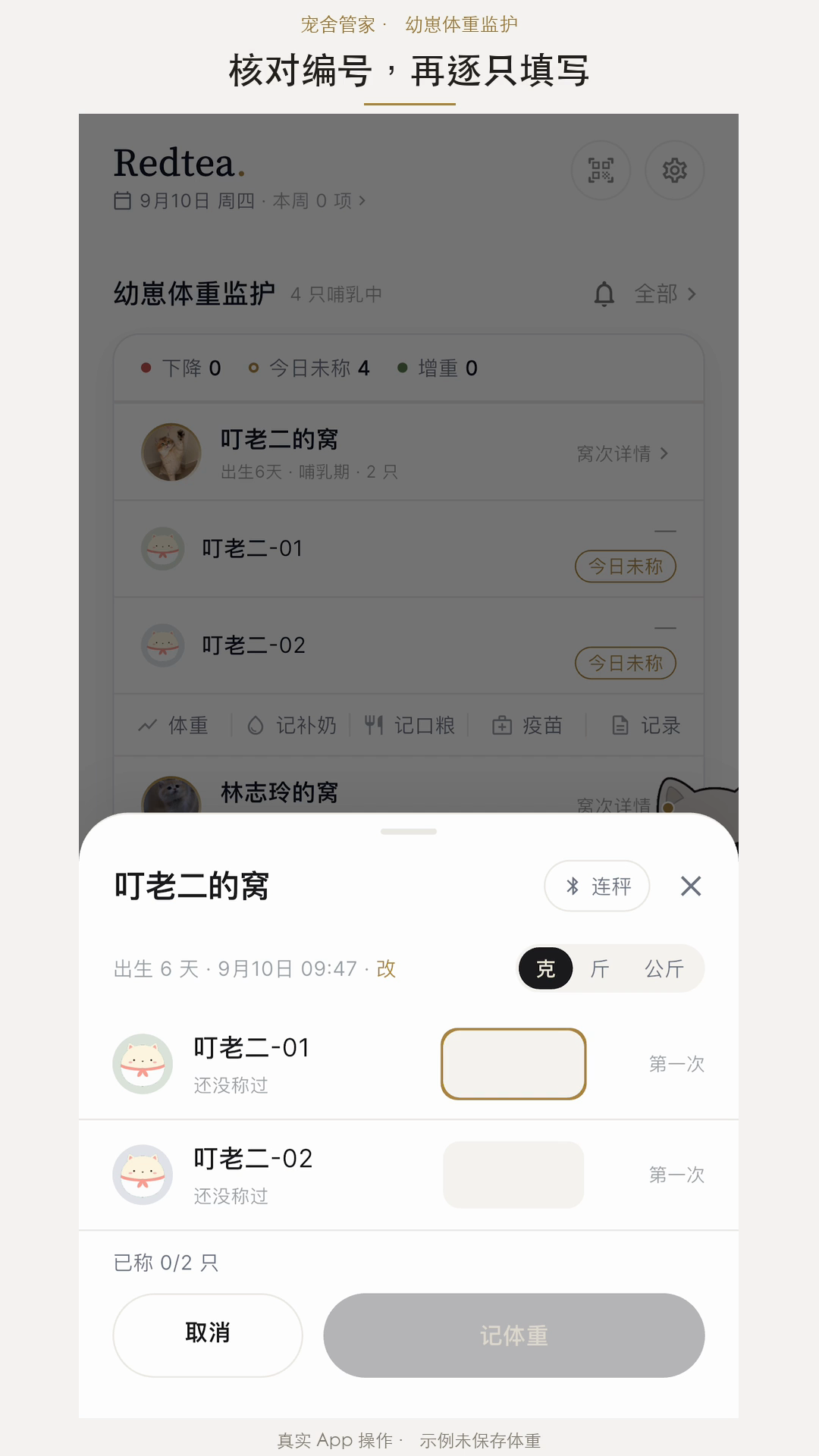
Recorded on 10 September 2026 in a demonstration account running app version 3.0.7 (108). The screenshots show the Simplified Chinese interface. This is a product demonstration, not a customer success story, and newer versions may look different.
The home screen shows four kittens without a weight recorded for that day. Dragging the Xiaofan companion to the weight-monitoring module reveals an action; selecting it opens the relevant litter form, where kitten identifiers and the unit can be checked.
The recording verifies the prompt and form navigation only. No weight was entered or saved and no AI chat request was sent. It does not demonstrate automatic weighing, successful record storage or a measured reduction in missed tasks.
Moving from a spreadsheet: reconcile a small batch first
Keep the original spreadsheet and photos. In a copy, check stable identifiers, names, birth dates, parent links and weight units. Start with the current litter and reuse an existing animal record where one is already present.
If a candidate offers import, review duplicates, dates and field mapping before confirming writes. Afterwards, check record counts and relationships. Do not invent missing historical values. This guide does not promise lossless, one-click import of every spreadsheet.
- Link the animals in the current litter.
- Add an actual record and check that you can find it again.
- Try an export and inspect the fields and media you need.
- Bring in historical records as the need arises.
Private records and public presentation are separate choices
FanMeowy supports internal record keeping and optional public presentation. Choose the appropriate private-use mode and review individual display settings before deciding what to publish.
Publishing a page does not guarantee search indexing, rankings or enquiries. Health records and reminders support record keeping; they do not replace observation or veterinary assessment.
Frequently Asked Questions
Are FanMeowy and Cattery Manager: Breeding different apps?
No. FanMeowy is the brand; Cattery Manager: Breeding is the US App Store name of the app listed as 宠舍管家 in China and 寵舍管家 in Taiwan. The shared App Store entry is 6753983437.
Is FanMeowy completely free?
The App Store download price is free, but feature access has separate conditions. Daily records and bookkeeping are currently unlimited by default; profiles and breeding plans have free allowances, with optional rewarded-video unlocks at some overflow entry points. Membership and some AI credit usage are separate.
Is every membership an annual subscription?
No. Fixed-duration one-time purchases coexist with monthly and yearly auto-renewing iOS plans. Check billing type, duration, renewal conditions and benefits. A fixed-duration purchase is not a lifetime licence.
Can I keep records without publishing my cats?
You can choose the private record-keeping direction and review display settings. You decide what to make public; internal records do not require a public sales listing.
Do I need to leave a spreadsheet that already works?
Not necessarily. Spreadsheets can manage relationships using identifiers, sheets and formulas. Compare the actual effort required to maintain records, photos, reminders and handovers, rather than assuming software with more features will suit you better.
Does an absent App Store search result prove an app was removed?
No. Check the official store link, your storefront region, device compatibility and the provider’s current information before drawing that conclusion.
Does the walkthrough demonstrate automatic weighing or guaranteed alerts?
No. It shows missing-entry information and navigation to a litter form. Actual weight must be measured and correctly recorded; notification delivery depends on settings and operating conditions.
Start with the litter you are caring for today. Get FanMeowy Cattery Manager